


















Articles
Three ways to treat missing teeth
 send

Many people are troubled by tooth loss due to cavities or periodontal disease. There is also a good chance that you may lose a tooth through sports. In this article, we will introduce three recommended treatment methods for when you lose a tooth. Each treatment method has its advantages and disadvantages, so even if you are not currently worried, it is important to know about the treatment methods as preliminary knowledge. Please use this information as a reference.
Three ways to treat missing teeth
If you have lost a tooth, there are three treatment options available to you:
- Implant
- bridge
- denture
About implants
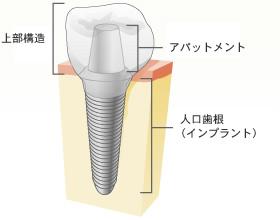
An implant is a procedure in which an artificial tooth root (made of titanium) is inserted into the area where a tooth has been lost, and an artificial tooth cap is attached on top of it. Compared to bridges and dentures, implants have a structure that is closest to that of natural teeth. Also, out of the three treatment methods, "implants" are the most recommended treatment because they put the least strain on the surrounding healthy teeth.
利 点
- It has the closest structure to natural teeth, so it looks almost natural and identical to natural teeth.
- The treatment is only performed on the area where the tooth has been lost, so there is no damage to the surrounding healthy teeth.
- When eating, you can enjoy the taste and temperature of food just like you would with healthy teeth.
- You can chew food in almost the same way as with natural teeth, so there is no discomfort when chewing food.
- Since you can chew food almost the same way as with natural teeth, your facial muscles will not weaken, which helps prevent facial aging (wrinkles, etc.).
- With regular maintenance after implant surgery, you can use your implants almost permanently.
- The structure is almost similar to that of natural teeth, so it fits securely with other teeth.
- Losing just one tooth can make it difficult to pronounce words as you normally would, but implants can help alleviate this problem.
Points to remember
- No hospitalization is required, but surgery is required.
- If there is little bone, treatment to regenerate bone tissue (GBR) may be necessary, which may extend the treatment period.
- Depending on the results of detailed examinations such as CT scans, implant treatment may not be possible.
- In some cases, the cost of treatment may be higher than that of regular dentures, bridges, etc.
About Bridges
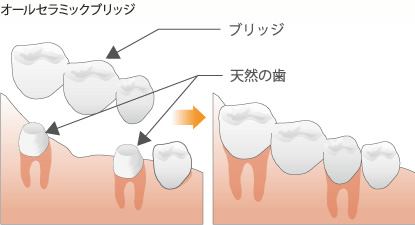
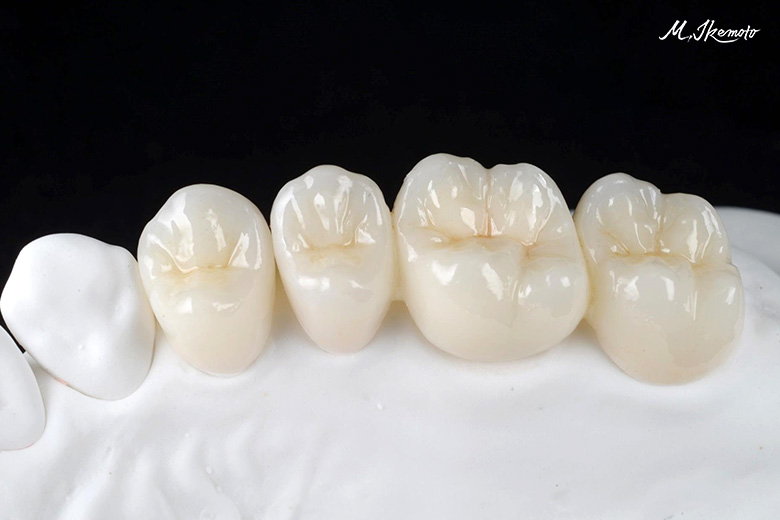
A bridge is a treatment method to replace a missing tooth by grinding down the teeth on either side of the missing tooth and fitting a "cap that connects the missing tooth and the teeth on either side that support it". This is a treatment method used when there are only 1 or 2 missing teeth. Bridges are not removable like dentures. Please note that once teeth are ground down or chipped, they cannot be restored to their original state.
利 点
- Compared to dentures, bridges are fixed with connected caps, so they are more stable and cause less discomfort.
- Depending on the location of the bridge, insurance may be applicable, making treatment relatively inexpensive.
- The procedure is completed faster than with implants
Points to remember
- A bridge requires the healthy adjacent teeth to be filed down in order to hold the connected caps in place.
- If there is a problem with the supporting teeth, the supporting teeth must be treated first.
- Because the crown is fixed to the adjacent teeth to replace the lost tooth, the adjacent teeth are subjected to strain when chewing food. As a result, the lifespan of the adjacent teeth, which were originally healthy, is shortened over time.
- Air can leak between the teeth, affecting your speech
- Food debris can get stuck in the gap between the bridge and your gums, making your mouth less hygienic and increasing the risk of tooth decay and periodontal disease.
About dentures
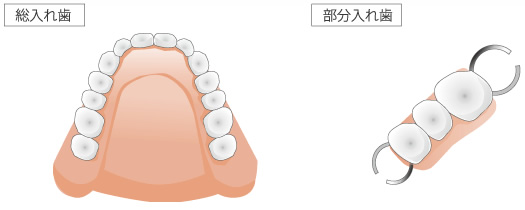
Dentures are made by connecting several artificial teeth with artificial resin to the area where several teeth have been lost due to some reason. The method is to fix the dentures to the healthy surrounding teeth or gums and restore the ability to chew food. "Dentures" are a treatment method suitable for cases where three or more teeth have been lost. If all teeth are missing, "full dentures" are used, and if some are missing, "partial dentures" are used. Unlike bridges, dentures are removable.
利 点
- Even in areas where bridges are not possible and three or more teeth have been lost, dentures can be used to treat the area.
- There are many variations in dentures available and they can be made to suit the individual patient's needs.
- There are also dentures that are covered by insurance, so treatment can be done at a relatively low cost.
Points to note about partial dentures
- Since dentures are fixed with the teeth on either side of the missing teeth, dirt can easily accumulate on the clasps that hold them in place, making you more susceptible to cavities and periodontal disease.
- Because dentures are fixed using the teeth on either side of the missing tooth, the lifespan of the healthy teeth on either side of the dentures will be shortened over time.
- You may feel discomfort in the teeth that hold your dentures in place
- The metal clasp that secures the product may spoil the appearance.
Points to note about complete dentures
- Since dentures are fixed in place by the mucous membrane in your mouth, you may feel some discomfort until you get used to them.
- Because dentures are fixed in place by the mucous membrane inside your mouth, they may occasionally come loose, causing problems when eating or speaking.
- Because dentures are fixed by the mucous membrane in your mouth, the heat from food is not easily transmitted, and you may not be able to taste the original flavor of food.
- Since it is fixed to the gums, it may be difficult to eat hard foods.
General points to note about dentures
- It needs to be removed periodically for cleaning
- The jawbone that normally supports your natural teeth may recede due to tooth loss, making your dentures unstable.
- Because you cannot chew food in the same way as with natural teeth, your facial muscles may gradually weaken, accelerating facial aging.
Summary
Treatment options vary depending on the patient's oral condition and requests, such as which treatment is best for your lifestyle and budget, or whether a different treatment is appropriate. It may be difficult to make a decision on your own, so we recommend that you consult with your regular dentist to decide on a treatment method.